Trigger over CoaXPress
Characteristics of Trigger over CXP and their benefits for demanding machine vision applications
Simple and performing: precise camera triggering over CoaXPress with Host to Device trigger
CoaXPress is a popular machine vision interface technology for applications requiring high bandwidth for high-speed transmission of high-resolution images. But the benefits of CoaXPress are not limited to bandwidth. The standard also provides advanced built-in capabilities for precise triggering that surpass other machine vision standards such as GigE Vision or USB3 Vision.
This article describes the characteristics of Trigger over CXP and their benefits for demanding machine vision applications.
Built-in functionality of the CoaXPress standard
The CoaXPress Host To Device Trigger is part of the CoaXPress standard. This functionality of the CoaXPress I/O Channel allows the host (frame grabber) to trigger the device (camera) through the CoaXPress Link.
The trigger signal can be initiated by different sources:
- A software command from the image processing application
- The trigger output of the camera itself (for example for a trigger sequence)
- The illumination controller
- Any other sensor or actuator connected to a frame grabber’s general purpose I/O (GPIO)
As a result, trigger over CoaXPress is perfectly suited for industrial applications where a precise timing of image capture or synchronization of the camera with other system components like light, other cameras or sensors is essential.
Simplified system architecture with single cable connection
CoaXPress triggers are transported in a single cable lane along with camera control data, the highspeed image data stream, and camera power. This single cable solution reduces the complexity of the setup, making it easier to install and maintain. This is particularly beneficial in environments where space is limited or where multiple cameras need to be installed. It also eliminates the need for additional I/O cables, reducing overall system costs.
Low latency and minimal jitter
Whatever the interface standard, triggering over the interface rather than I/O ports always raises concerns in time-critical applications. However, many system engineers ignore that CoaXPress triggers with a very low latency and jitter.
Latency (or delay) is the time a signal needs to be physically transmitted between the sender and the receiver of the signal. As a physical value, it is a constant in theory.
However, in real life, variations occur. The amplitude of these variations is known as jitter. In machine vision, a low latency is important to achieve fast inspection tasks, but jitter is even more important because it impacts the predictability of the performance of a system.
CoaXPress trigger signals have a very low latency, under 0.5 microseconds (µs). This makes this interface highly reactive to control inputs, ensuring quick and precise responses. This is beneficial for event-driven triggers, for example for actuator-driven applications or when a sensor detects a fastmoving object in front of the camera.
As a comparison, a trigger signal fed directly from an actuator via a dedicated I/O cable has a typical latency of around 5 µs (or up to 25 µs for opto-coupled trigger), so the additional latency of trigger via the CXP cable is marginal.
On top of this very low latency, CoaXPress presents a Host to Device Trigger jitter corresponding to the delay until the next character boundary, which varies between 0 and 480 ns. This jitter value is cut down by the camera thanks to the CoaXPress jitter compensation feature: the camera automatically adds a variable delay to incoming trigger signals so the start of the exposure always corresponds to the latest possible rising edge trigger signal. This virtually eliminates jitter with a residual jitter as low as 2 ns!
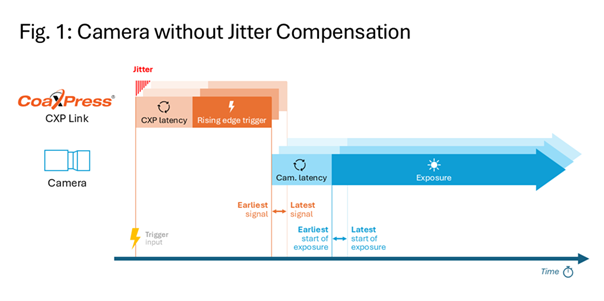
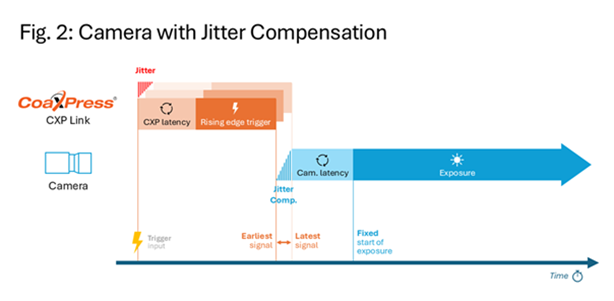
With jitter compensation, the trigger latency is not only extremely low, it is also virtually constant. This trigger predictability is ideal for line scan applications where precision and timing are crucial. In line scan applications, where images are captured one line at a time, even small variations in timing can lead to errors or inconsistencies in the captured images. By providing minimal jitter, CoaXPress jitter compensation ensures that the timing of the triggers is consistent and reliable.
Reliable trigger signal transmission with acknowledgment loop
In the CoaXPress standard, every trigger message transmitted must be acknowledged by the receiver. This ensures reliability and robustness in the communication between the camera and the frame grabber. The acknowledgment mechanism helps to prevent errors and ensures that the trigger messages are received and processed correctly. This is important in applications where reliability is critical, such as in medical imaging or quality control.
If the acknowledgment is received before the expiration of the preset timeout, the transaction terminates normally.
Note: Euresys CoaXPress frame grabbers offer an additional GenApi feature that allows system developers to fine-tune the timeout according to their application needs: CxpTriggerAckTimeout
If no acknowledgment is received within the timeout, the transmitter can perform a retry: it resends the trigger packet and initiates a new waiting period for the acknowledgment.
Note: Euresys CoaXPress frame grabbers can also configure the number of retries using Euresys’s CxpTriggerMaxResendCountGenApi feature.
If no acknowledgment is received after the defined maximum number of retries, the transaction terminates abnormally.
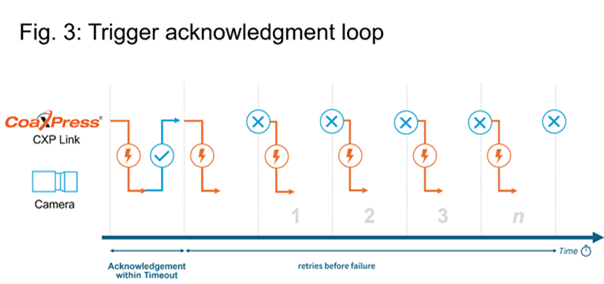
With their low latency, low jitter, and acknowledgment loop, CoaXPress triggers are highly deterministic, meaning they perform consistently and predictably. This is essential for industrial and scientific applications requiring precise timing and synchronization.
Control of camera exposure time
CoaXPress’ trigger capabilities go beyond the mere initiation of image capture. Using the standard’s commands, users can also control the camera’s exposure time.
This is achieved in the default trigger message format (Pulse). For each trigger, the transmitter generates two device transactions: One on the rising edge, and one on the falling edge of the signal. The gap between both signals allows the frame grabber to control the camera cycle. This provides developers additional flexibility to optimize image acquisition to their imaging conditions – for example object speed or lighting conditions.
Up to 78 MHz trigger rate
In the CoaXPress standard, the “upconnection” refers to the communication channel used for camera control and triggering from the frame grabber to the camera. Version 2.0 of the CXP standard doubles the speed of this upconnection, from 20.83 Mbps to 41.67 Mbps for CXP-10 and CXP-12 speeds. This allows for faster camera control and trigger rates, enabling trigger rates over 500 kHz without requiring a dedicated high-speed uplink cable.
CoaXPress allows for high trigger rates. Up to CXP-6, trigger rates up to 297.6 kHz are possible via the interface. CXP-10 and CXP-12 link speeds support rates up to 595.2 kHz. This makes trigger over CoaXPress suitable for high-speed imaging applications such as in-line inspection or real-time monitoring.
Should this frequency not be sufficient, even higher trigger rates are possible using CoaXPress’ optional High-Speed Upconnection feature.
By allocating a dedicated uplink cable to the upconnection, High-Speed Upconnection provides additional bandwidth and allows trigger rates up to 78 MHz at CXP-12 link speed.
Bidirectional Triggering
CoaXPress also supports triggers from the camera to the frame grabber. For example, the camera can control the start and stop of a scan, providing flexibility in various applications. Bidirectional triggering allows for more flexible and dynamic operation, as it enables the camera to send trigger signals to the frame grabber. This is important in applications where the camera needs to control the timing of the triggers, such as in automated inspection systems or real-time monitoring.
Conclusion
CoaXPress is not necessarily recognized for its triggering capabilities. However, compared to other machine vision interfaces such as GigE Vision and USB3 Vision, CoaXPress appears to be a hidden triggering champion with low latency and jitter, a highly reliable trigger signal transmission, high trigger rates and additional features such as exposure time control or bidirectional triggering. Using these capabilities, system engineers can design high-performance imaging systems with a simpler hardware setup at a reduced cost.